
No other surfaces in a kitchen do as much work, visually or practically, as the countertop and backsplash. They set the color palette for the entire room. They establish whether the space reads as traditional, transitional, or contemporary. They endure hot pans, knife slips, wine spills, and years of daily use. And unlike cabinetry or paint, they are among the most expensive and disruptive elements to change after installation.
Getting these selections right requires understanding the actual performance characteristics of each material, not just how it looks in a showroom. This guide covers the options we work with most often in Scottsdale kitchen remodels, with specific attention to the Arizona conditions that narrow the field more than most homeowners expect. If you are also thinking about how smart storage strategies complement your surface choices, those decisions go hand in hand.
Natural Stone Countertops
Natural stone remains the benchmark in luxury kitchens for a reason: every slab is unique, and the depth of color and veining that forms over millions of years simply cannot be replicated by engineered alternatives. But the differences between types of natural stone are significant, and choosing the wrong one for your lifestyle is a common and expensive mistake.
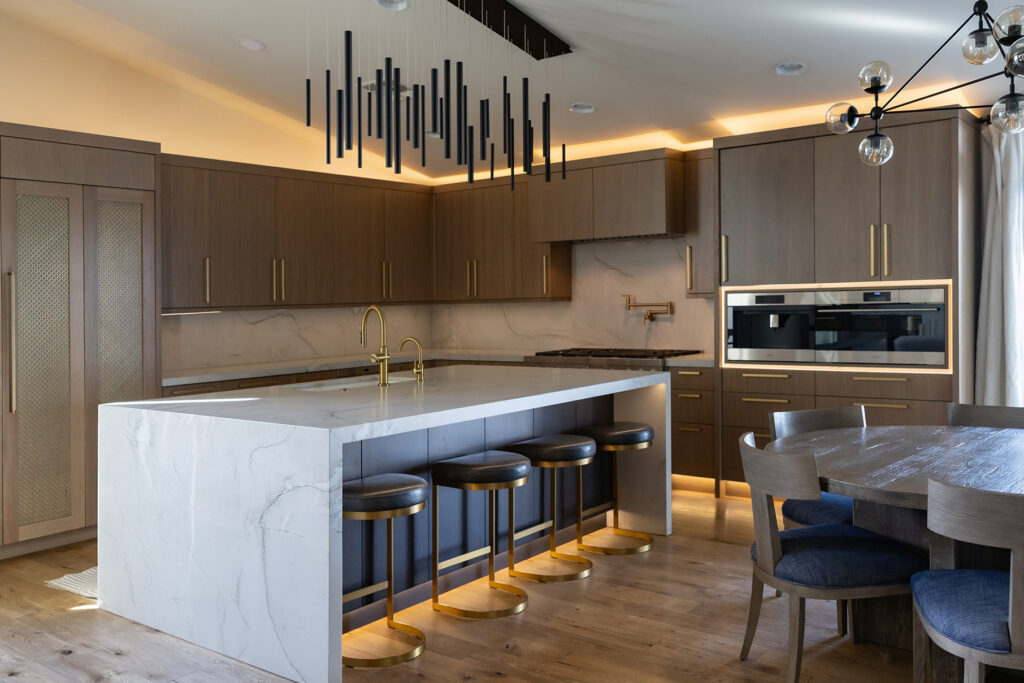
Marble is the material most people picture when they imagine a luxury kitchen. Calacatta, Carrara, and Statuario varieties deliver the dramatic veining and luminous depth that define high-end design. But marble is also the softest countertop stone, rating just 3 to 4 on the Mohs hardness scale. Its calcium carbonate composition means it etches on contact with acidic liquids like lemon juice, wine, or vinegar. This is a chemical reaction, not a stain, and no sealer can fully prevent it. Honed finishes disguise etching far better than polished ones, which is why most stone professionals recommend honed marble for kitchen use. Sealing is required every 6 to 12 months, and installed pricing ranges from roughly $40 per square foot for Carrara up to $250 or more for premium Calacatta Gold.
Granite occupies the practical center of the natural stone category. It rates 6 to 7 on the Mohs scale, tolerates temperatures up to around 1,200 degrees, and contains no calcite, which means it does not etch from acids. The color range is enormous, spanning from deep blacks through warm golds to rare blues. Maintenance is substantially less demanding than marble: sealing every one to five years, basic cleaning with dish soap, and annual upkeep costs that run a fraction of what marble demands. Installed pricing typically falls between $60 and $100 per square foot for most varieties, with exotic options pushing higher.
Quartzite is the material increasingly bridging the gap between marble’s beauty and granite’s resilience. True quartzite is a natural metamorphic stone (not to be confused with engineered quartz) that scores 7 to 8 on the Mohs scale, making it the hardest natural countertop available. It resists acid etching, handles hot cookware, and is completely UV stable, meaning it will never fade in sunlight. That last property matters enormously in Arizona. The NKBA’s 2026 Kitchen Trends Report found that 61 percent of industry professionals identify quartzite as gaining popularity for both countertops and backsplashes. Varieties like Taj Mahal, with its warm ivory tones and gold veining, and Mont Blanc, which closely resembles Calacatta marble, are particularly popular in luxury installations. Installed pricing runs $65 to $220 per square foot depending on variety and rarity.
One important caution: many slabs marketed as quartzite are actually dolomitic marble. The Natural Stone Institute recommends acid and scratch testing before purchase. True quartzite will not etch from vinegar, and a steel knife will not scratch it.
Engineered Countertop Options
Engineered surfaces offer consistency and low maintenance that natural stone cannot match. Every slab looks identical to the sample you approved, there is no sealing required, and the nonporous composition resists staining. The tradeoff is that engineered materials have specific performance limits that natural stone does not.
Quartz countertops are made from roughly 90 to 94 percent ground natural quartz bound with polymer resins and pigments. The resin creates zero porosity and eliminates the need for sealing, but it also introduces vulnerability to heat (the resin begins to degrade at around 300 degrees) and UV light (prolonged sun exposure can cause yellowing or fading). Silestone, which Woodcrest sources directly, uses patented HybriQ+ technology with a minimum of 20 percent recycled materials and carries a 25-year transferable warranty. Caesarstone, another brand we work with, offers the industry’s only lifetime residential warranty. Both deliver excellent daily performance in kitchens where hot pans go on trivets and direct sunlight is managed. Installed pricing ranges from about $60 to $140 per square foot. You can explore the specific brands we carry on our luxury home products page.
Dekton represents a different category entirely. Made by Cosentino (the same company behind Silestone), Dekton uses sintered particle technology to fuse glass, porcelain, and quartz under extreme pressure and heat without any resin. The result is a material that tolerates temperatures exceeding 1,000 degrees, scores 7 to 8 on the Mohs hardness scale, achieves near-zero porosity, and is fully UV stable. It is the only countertop material explicitly marketed for safe direct hot-pan contact and outdoor use. For kitchens with pass-throughs to outdoor entertaining areas, which are increasingly common in Scottsdale, Dekton is a strong contender. Installed pricing runs $70 to $120 per square foot, with a 25-year transferable warranty.
Porcelain slabs are a newer entrant worth noting. Fired at approximately 2,550 degrees, large-format porcelain from brands like SapienStone and Laminam delivers heat resistance above 1,200 degrees, full UV stability, and zero porosity in remarkably thin profiles. Porcelain convincingly mimics marble and other natural stones at $60 to $120 per square foot installed. The primary drawback is chipping: if a glazed porcelain edge is damaged, the different-colored clay body underneath becomes visible.
Backsplash Materials and Design Approaches
The backsplash is where a kitchen’s personality shows most clearly. It occupies prime visual real estate between countertop and upper cabinetry, and the material, format, and coverage you choose will either tie the room together or pull it apart.
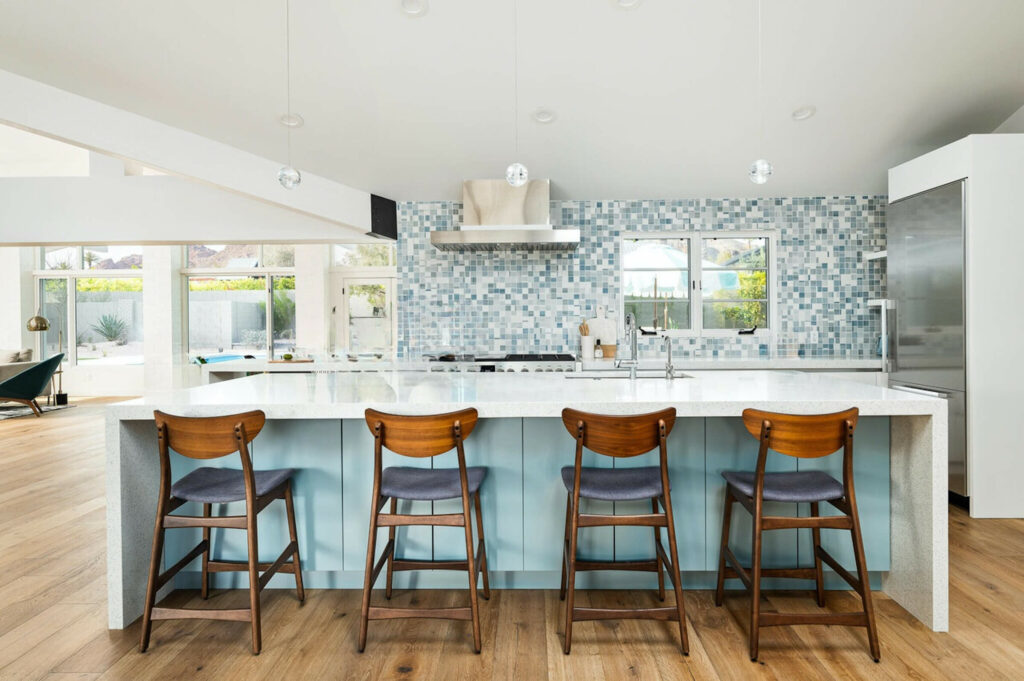
The most significant backsplash trend in luxury kitchens right now is height. Full counter-to-ceiling coverage has replaced the old standard of a short strip between countertop and upper cabinets, and slab backsplashes, where a single piece of stone or engineered material runs uninterrupted from counter to ceiling, rank as the fastest-growing backsplash approach in the NKBA’s most recent industry survey. The absence of grout lines creates a clean, architectural quality that tile cannot quite replicate, and when the backsplash is fabricated from the same slab as the countertop, the veining flows seamlessly from horizontal to vertical surface.
Tile remains the most versatile and widely used backsplash material, and the options have expanded well beyond classic subway tile. Elongated formats like 4×12 and 3×12 produce fewer grout lines and a more contemporary profile than the traditional 3×6. Zellige tiles, handmade Moroccan glazed terracotta with centuries of craft tradition, have become a prestige artisan choice. Their luminous, light-catching surface with intentional variation gives kitchens a warmth and character that factory-produced tile cannot achieve. Color direction has shifted decisively toward greens, blues, and warm earth tones, with sage, terracotta, and muted clay replacing the cool whites that dominated the past decade.
Waterjet-cut marble mosaics represent the highest-end tile option, with intricate patterns precision-cut from natural stone, sometimes with brass or mother-of-pearl inlays. Full-slab metal or glass backsplashes are less common but can work beautifully in specific contemporary contexts.
Coordinating Countertops and Backsplashes
This is where many kitchen remodels go wrong, not because homeowners choose bad materials individually, but because the combination creates visual competition rather than cohesion.
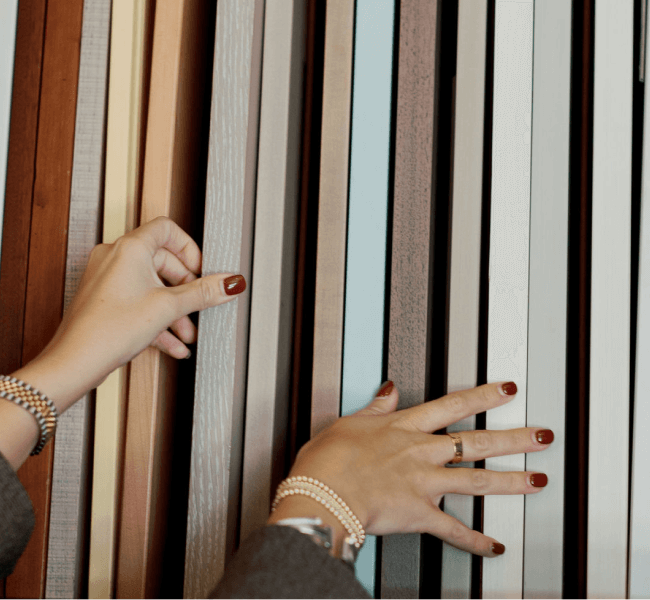
The core principle professional designers follow is simple: one surface commands attention, and the other supports it. A dramatic Calacatta marble countertop pairs with a quiet white subway tile backsplash. A bold patterned backsplash sits above a solid, understated surface. When both countertop and backsplash compete for attention simultaneously, the kitchen feels busy rather than designed.
A useful framework is the 60-30-10 rule adapted for kitchen surfaces. Approximately 60 percent of the visual weight comes from cabinetry (the dominant surface), 30 percent from countertops or backsplash (the secondary surface), and 10 percent from hardware, fixtures, and accessories (the accent). This proportion naturally prevents the most common coordination mistake: too many competing patterns. Professional consensus limits a kitchen to two or three materials across countertop, backsplash, and flooring, with only one carrying a bold pattern.
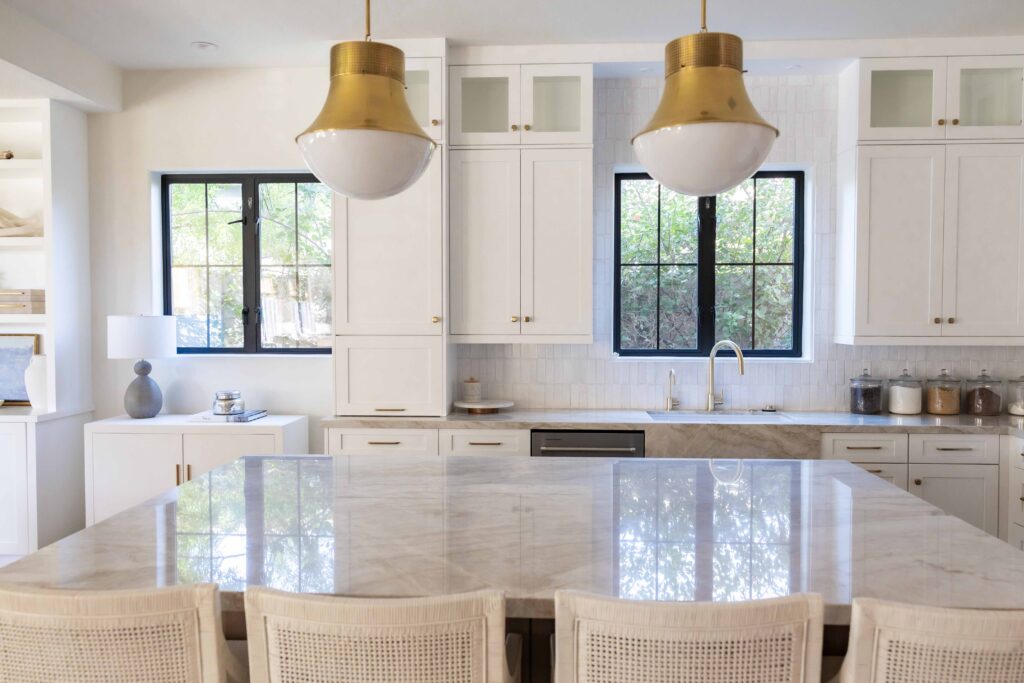
Undertone matching matters more than exact color matching. All visible surfaces should share either warm undertones (creams, beiges, golds) or cool undertones (grays, charcoals, whites). Mixing warm and cool creates a subtle but persistent visual tension that even people who cannot articulate the problem will instinctively notice. And always select the countertop first. It is the larger, more dominant surface, and it establishes the palette that the backsplash and custom cabinetry finishes need to harmonize with. Our upcoming guide to cabinet door styles will cover how cabinetry finishes factor into this coordination in more detail.
Practical Considerations for Arizona Kitchens
Scottsdale’s climate introduces three material constraints that national buying guides rarely address, and ignoring them can lead to premature aging of surfaces that should last decades.
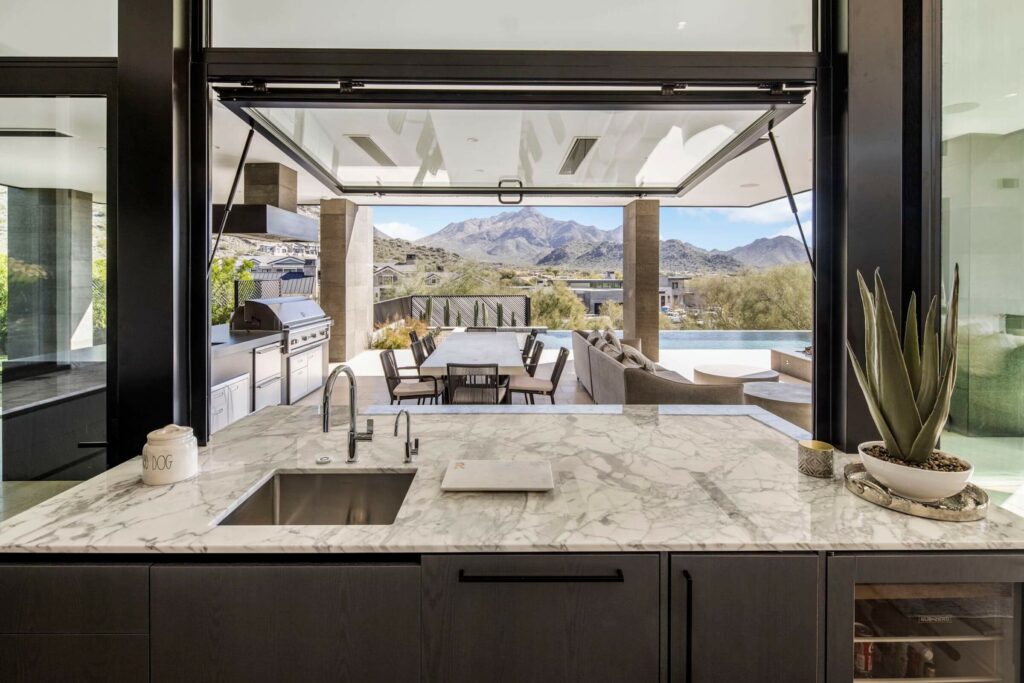
UV exposure is the biggest concern. With 300-plus days of sunshine and luxury homes featuring expansive glazing, Scottsdale kitchens expose countertops to UV levels far above national averages. Standard engineered quartz is not UV resistant. The resin binders degrade under prolonged direct sunlight, causing yellowing in lighter colors and fading in darker ones. Local fabricators have documented visible fading on dark quartz within weeks of outdoor sun exposure. If your kitchen has large south- or west-facing windows, a skylight, or a pass-through to an outdoor entertaining area, granite, quartzite, Dekton, and porcelain are all fully UV stable and appropriate without restriction. If quartz is strongly preferred for other reasons, UV-blocking window film provides meaningful mitigation. Our upcoming guide to indoor-outdoor kitchen design will explore how material choices factor into these transitional spaces.
Heat compounds the issue. When summer temperatures regularly exceed 115 degrees, countertop surfaces near outdoor pass-throughs already carry significant ambient heat before a hot pan arrives. This compounding effect is especially dangerous for quartz, where the resin degradation threshold can be approached by ambient temperature alone in semi-outdoor configurations.
Arizona’s hard water, commonly above 200 PPM calcium and magnesium, creates a daily maintenance challenge that affects every surface material. On dark polished stone and glossy quartz, mineral deposits leave cloudy white residue that becomes more annoying than staining or etching for most Scottsdale homeowners. A whole-house water softener is the single most effective countermeasure. Beyond that, wiping surfaces before water evaporates, using pH-neutral cleaners, and resealing natural stone on an accelerated 6- to 12-month schedule will keep surfaces looking their best in the desert climate.
Choosing with Confidence
The right countertop and backsplash combination does not come from picking the most expensive option or following the latest trend. It comes from matching material properties to how you actually use your kitchen, coordinating surfaces so they work as a cohesive whole, and accounting for the specific environment where those materials will live.
In a market like Scottsdale, where sunlight, heat, and hard water test materials more aggressively than in most parts of the country, these choices benefit from professional guidance. An experienced design team can help you see physical slabs in person, test material samples under your kitchen’s actual lighting, and coordinate your selections with cabinetry, flooring, and hardware into a result that feels intentional from every angle.Work with us to start planning your kitchen’s material palette.